
Why Benicia Works for Job Relocation to the San Francisco Bay Area
Overlooking Benicia 1st Street towards Carquinez Strait
Benicia Relocation Guide
Waterfront Small-Town Lifestyle in the Bay Area

Neptune’s Daugher, a 6’ bronze sculpture on the Benicia Waterfront
If you’re searching for a rental home in the Bay Area but want something quieter, more charming, and still well-connected, Benicia offers a unique balance that’s increasingly hard to find.
Located along the Carquinez Strait in southern Solano County, Benicia combines a historic downtown, scenic waterfront living, and convenient access to major job centers—all wrapped in a true small-town feel. Photos of Benicia around town.
Why Rent in Benicia?
Benicia stands out for renters who want:
A walkable, community-oriented town
Water views and outdoor lifestyle
Less congestion than central Bay Area cities
More space for your rent dollars
It’s one of the few places in the Bay Area where you can feel removed from the intensity of urban life while still being within commuting distance of major employment hubs.
The Lifestyle: Waterfront Living Meets Small-Town Charm
Benicia is known for its peaceful, coastal atmosphere and strong sense of community.
Highlights:
Historic Downtown (First Street)
Lined with local restaurants, boutiques, art galleries, and coffee shopsWaterfront Parks & Walking Trails
Benicia State Recreation Area offers miles of scenic paths along the waterMarina and Boat Access
Ideal for kayaking, sailing, and fishingCommunity Events
Farmers markets, art walks, and seasonal festivals create a welcoming, neighborly vibe
Unlike busier Bay Area cities, Benicia has a slower pace—making it especially appealing for remote workers, families, and professionals seeking balance.
Rental Market & Cost of Living
How Benicia Compares
In general, costs decrease as you move further from San Francisco—and Benicia sits in a выгодный middle ground.
More affordable than:
San Francisco, Oakland, Berkeley, Walnut CreekComparable to or slightly higher than:
VallejoOften more affordable than:
Marin County waterfront areas (with similar water access)
What Renters Can Expect
Strong demand for single-family homes and townhomes
Larger properties compared to inner Bay Area cities
Better likelihood of:
Garage parking
Outdoor space
Quiet neighborhoods
For renters relocating from SF or Silicon Valley, Benicia often provides more space and better value without leaving the Bay Area ecosystem.
Benicia’s location makes it surprisingly versatile for commuters.
Driving Access
I-680 and I-780 connect Benicia to:
Walnut Creek / East Bay
Napa & Solano County
Quick access to Highway 80 via nearby Vallejo
Approximate Commute Times (traffic dependent)
Walnut Creek: ~25–35 minutes
Oakland: ~35–50 minutes
San Francisco: ~45–70 minutes
Napa: ~25 minutes
Public Transit & Alternatives
SolTrans & County Connection buses
Nearby Vallejo Ferry Terminal → direct ferry service to San Francisco (popular option for a stress-free commute)
Casual carpool options toward SF
BART stations in Concord and Richmond - regional rail access to the entire Bay Area
Nearby Job Centers
Benicia is centrally located between multiple employment hubs:
East Bay
Walnut Creek (finance, healthcare, professional services)
Concord (government, logistics)
North Bay
Napa (tourism, hospitality, wine industry)
Solano County
Vallejo (Kaiser hospital, government jobs)
Fairfield (Travis Air Force Base, distribution and manufacturing)
Broader Bay Area Access
With a longer commute or ferry connection:
San Francisco (tech, finance, startups)
Oakland (healthcare, port, tech)
This makes Benicia a strong choice for renters who work hybrid schedules.
Neighborhood Feel
Benicia doesn’t have sharply divided districts like larger cities—but each area offers a slightly different feel:
Downtown / West Side
Walkable to shops and waterfront
Historic homes and character
Southampton
More suburban feel
Newer homes, quiet streets, parks
East Benicia
Mix of residential and light industrial
More affordable rental pockets
Schools & Community
Benicia is known for:
Well-regarded public schools
Safe, family-friendly neighborhoods
Active local community involvement
Even for renters without children, this translates into well-maintained neighborhoods and a strong civic atmosphere.
Outdoor Recreation
Nature is a big part of daily life here:
Benicia State Recreation Area
Waterfront promenade & beaches
Easy access to:
Napa Valley wineries
Mount Diablo hiking
Delta waterways
For those who value weekend escapes without long drives, Benicia is ideally situated.
Is Benicia Right for You?
Benicia is a great fit if you’re looking for:
✅ A quieter alternative to dense Bay Area cities
✅ Waterfront living without ultra-premium pricing
✅ A strong sense of community
✅ Reasonable access to multiple job hubs
✅ More space for your monthly rent
It may be less ideal if you need:
Daily commutes deep into Silicon Valley
A fast-paced urban nightlife scene
Extensive public transit directly within town
How we Make it Easy For You.
Convenient on-line process
All of our home listings include several high quality photos of all spaces so you can "shop from afar"
We are the only local option that provides YouTube Video Home Tours
Typically a large quantity of Homes Available Now
Typically a large quantity of Homes Coming Soon
We have years of experience helping people find a home in Benicia
We are happy to answer your questions: 707-297-6800.
Final Thoughts
Benicia offers something increasingly rare in the Bay Area: a true small-town waterfront experience without sacrificing regional connectivity.
For renters relocating from outside the area, it’s often a welcome surprise—combining charm, livability, and value in a way few surrounding cities can match.
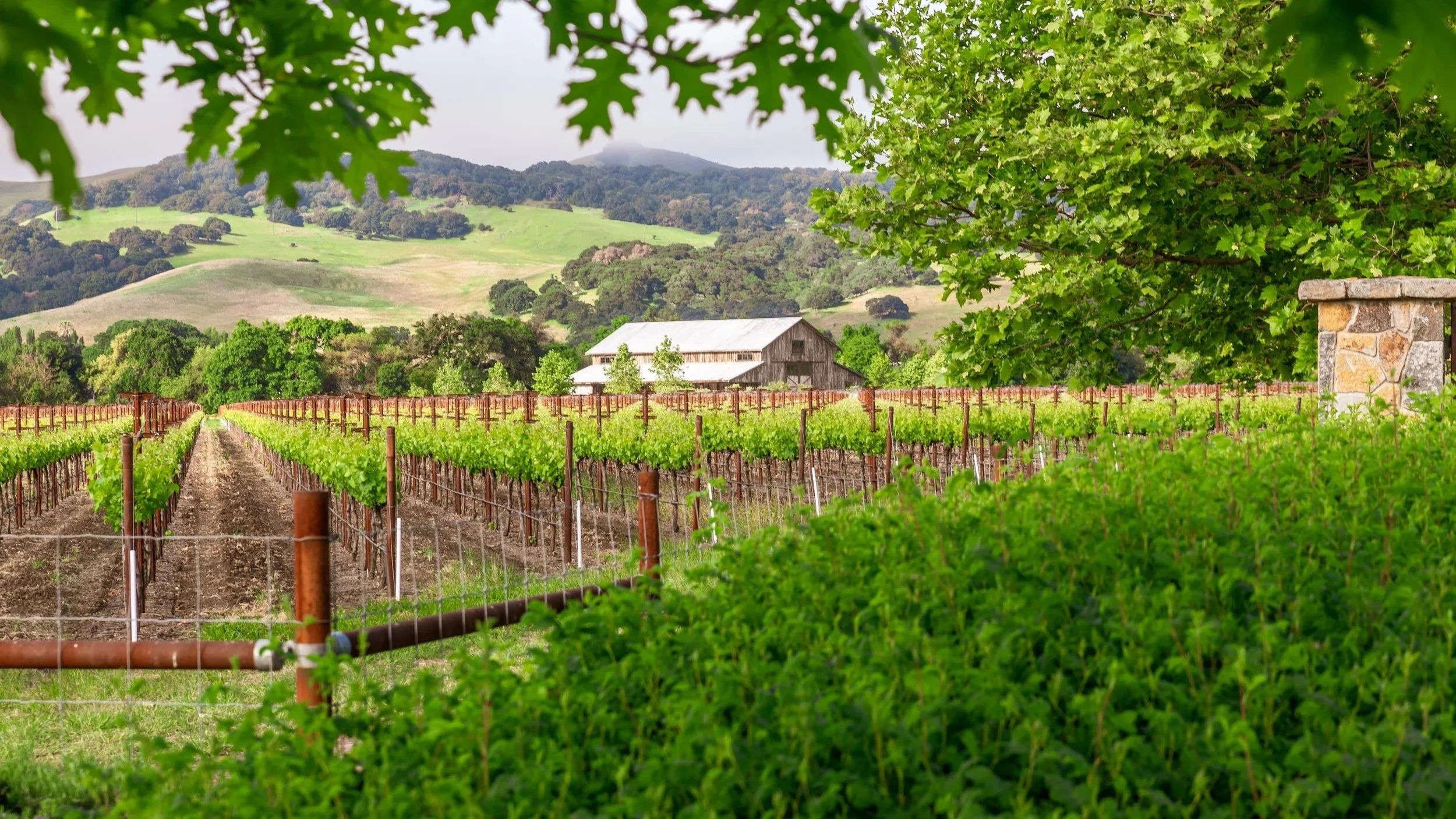
Why Solano County Works for Bay Area Job Relocation
Solano County: Space to Breathe, Access to Work
Solano County: Space to Breathe, Access to Work
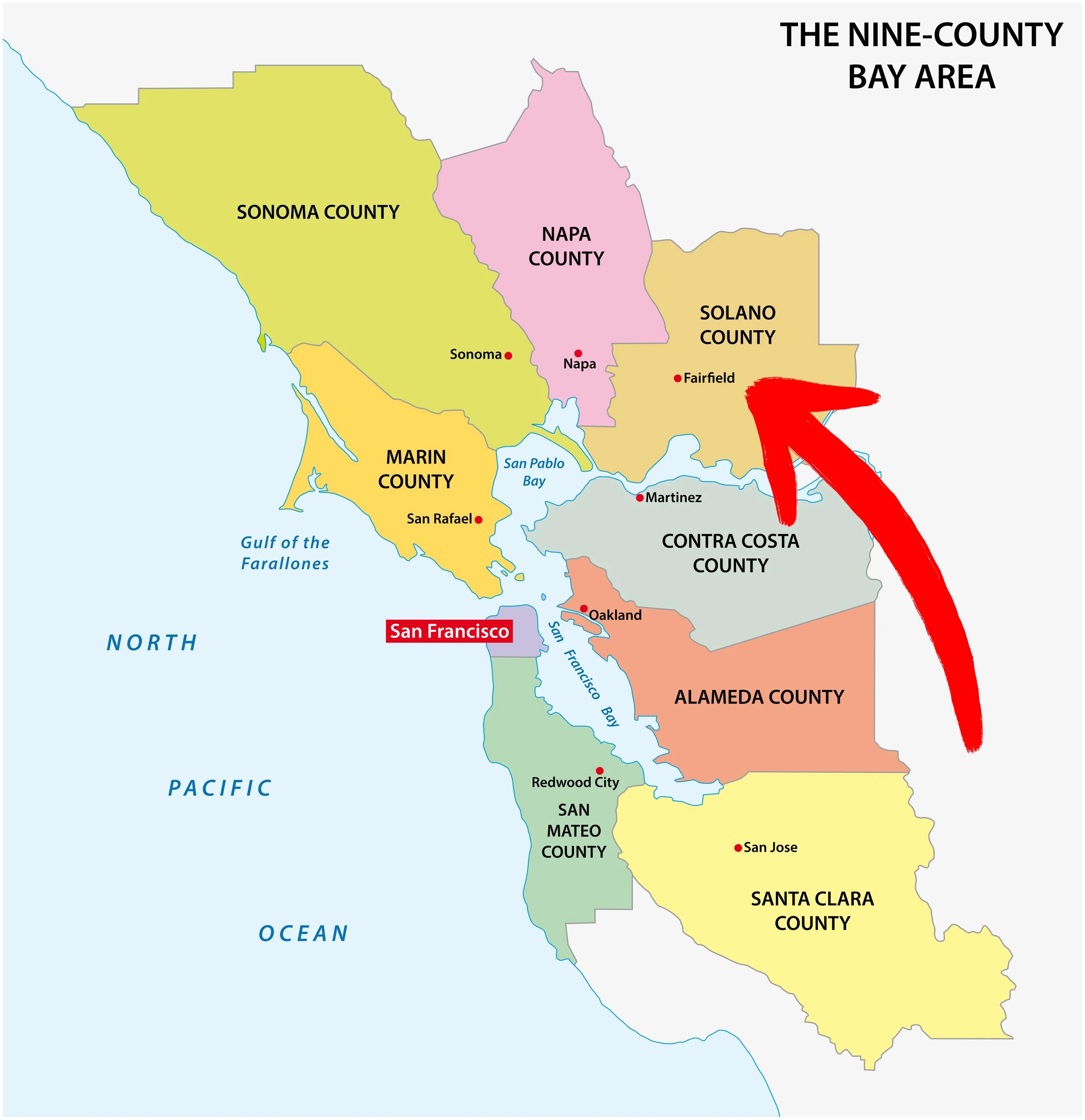
Nine-County SF Bay Area, with Solano County
For renters relocating due to a new job offer, Solano County often works as a practical middle ground—room to live, several commute paths, and access to major job centers without needing to live at the center of everything. This post looks at Solano County as a “space + access” home base and how renters use it thoughtfully when moving to the area and starting a new role.
Relocation Snapshot: Why Solano County Works for New-Job Moves
Solano County sits between the San Francisco Bay Area’s major employment centers and the Sacramento region, which gives renters options as work schedules, offices, and teams evolve. Cities like Vallejo, Fairfield, Vacaville, and Benicia are positioned along established transportation corridors rather than at the far edges of the region, which helps explain why many people choose Solano when relocating for work rather than waiting to “trade up later”. [labormarke...edd.ca.gov]
With its unique blend of rural charm and suburban convenience, Solano County offers residents the best of both worlds—peaceful living with easy access to the dynamic urban centers of San Francisco and Sacramento
The county’s mix of urban centers, industrial job sites, health systems, education institutions, and public-sector employers supports a variety of careers without tying renters to a single commute pattern or employer ecosystem. [labormarke...edd.ca.gov]
After‑Work Nature: Open Space, Water, and Easy Reset Spots
One factor that consistently draws renters to Solano County is how quickly workdays can end with quiet or open space. The county includes shoreline areas along the Carquinez Strait and San Pablo Bay, inland hills, and agricultural land, creating everyday access to water views, trails, and outdoor space without needing to plan a full weekend trip. [labormarke...edd.ca.gov]
For renters balancing a new job and a new home, these “short reset” moments—an evening shoreline walk, a nearby regional park, or time near the water—often become part of weekly routines rather than occasional outings.

The Benicia Waterfront at First St.
Weekend Culture: Local Towns, Family‑Friendly Attractions, and Food Experiences
Weekends in Solano County tend to be locally focused and easy to plan. The county is home to a range of family‑friendly attractions, community events hosted by individual cities, and destination spots that residents revisit casually rather than treating as one‑time activities. Examples include waterfront areas, amusement attractions, and seasonal community programming supported by local governments and institutions. [labormarke...edd.ca.gov]
Food and beverage experiences often reflect the county’s location between Napa, Sacramento, and the Bay Area—chocolate makers, long‑standing confectionery companies, and local producers operate alongside independent restaurants and tasting experiences, particularly in Benicia, Fairfield, Vacaville, and surrounding areas. [labormarke...edd.ca.gov]
Links to local Events Calendars:
Links to Local Restaurant Guides:
Work & Job Hubs: A Look at Major Employers
According to the California Employment Development Department (EDD), Solano County’s major employers span healthcare, manufacturing, education, logistics, energy, retail, government, and military operations. [labormarke...edd.ca.gov]
Examples include:
Healthcare: NorthBay Health, Sutter Solano Medical Center
Education: Touro University California
Manufacturing & Industry: Collins Aerospace, Guittard Chocolate Company, Jelly Belly Candy Company
Government & Military: Travis Air Force Base, Solano County agencies
Energy & Infrastructure: Valero Benicia Refinery (news reports this may be shutting down)
This mix supports a wide range of job types and helps explain why many renters choose Solano County even when their primary office is outside the county. [labormarke...edd.ca.gov]
Commute Playbook: Ferry Commuting from Vallejo
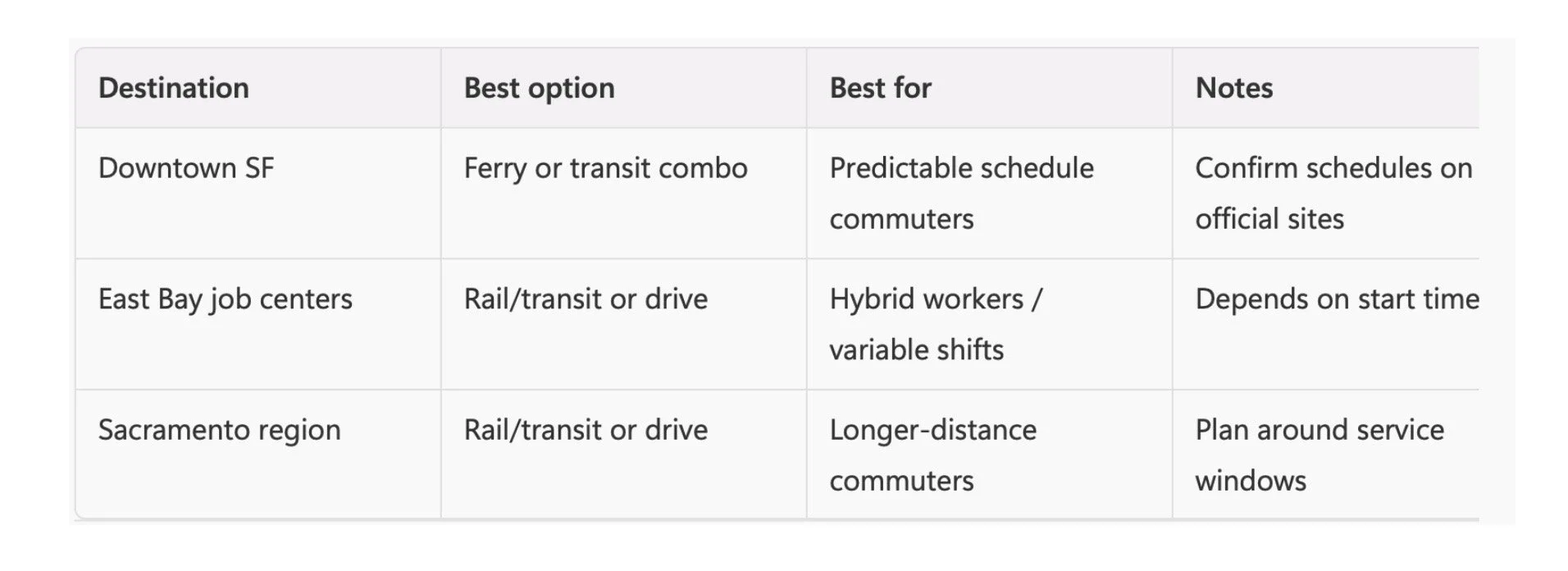
For renters working in San Francisco, the Vallejo ferry is a central commute option. San Francisco Bay Ferry operates daily service between Vallejo (and Mare Island) and Downtown San Francisco, with routes and schedules published directly by the agency. [sanfrancis...yferry.com]
The ferry is often used by downtown office workers and hybrid employees who want a consistent, seated commute and a clear separation between work and home. Riders check official schedules and alerts through SF Bay Ferry rather than relying on generalized commute estimates. [sanfrancis...yferry.com]
Link to SF Bay Ferry
Regional Connections: Capitol Corridor and Transit Networks
For east‑west and north‑south travel, Amtrak’s Capitol Corridor connects Solano County cities to Sacramento and the Bay Area. The Capitol Corridor notes connections with BART and SF Bay Ferry as part of the region’s integrated transit concept, particularly via transfer stations such as Richmond and connecting bus or rail systems. [capitolcorridor.org]
Link to Amtrak Capitol Corridor
Link to Bart
These connections are relevant for renters with variable schedules, regional travel needs, or multi‑office work weeks that don’t match a single commute pattern.
Commute Options Matrix
Value Framing: Space Without Leaving the Region
Many renters look at Solano County for overall value rather than specific price points. The appeal is often the ability to prioritize space, flexibility, and access without needing to live at the center of the most competitive housing markets. For people relocating on short timelines, this balance can reduce pressure during the move while keeping long‑term options open.
Relocation‑Ready: How We Help You Land Fast
When you’re relocating for a new job, speed and clarity matter. We help renters secure housing efficiently while staying focused on logistics, not guesswork. In complete transparency, our focus is on the waterfront town of Benicia, and not the entirety of Solano County.
Our relocation checklist support includes:
Confirming availability timelines that match your job start
Reviewing lease terms clearly and transparently
Coordinating application steps remotely
Helping you narrow locations based on commute patterns—not assumptions
Providing local move‑in guidance once you’re approved
If Benicia in Solano County might fit your relocation plan, we’re ready to help you land smoothly.
Link to our Benicia homes that are Available Now
Link to our Benicia homes that are Coming Soon
New job, new city? See why renters use Solano County as a space‑plus‑access home base.
Relocating for work doesn’t have to mean giving up flexibility—Solano County connects space with regional transit.

Why The East Bay Works for Bay Area Job Relocations
Oakland Bay Bridge
Relocating for Work? A Practical Look at the San Francisco East Bay
Starting a new job in the Bay Area often means making housing decisions quickly—sometimes before you’ve had a chance to learn the region. For many out‑of‑area renters, the San Francisco East Bay offers a steady, workable place to land while getting oriented.
When we say East Bay here, we’re including the Oakland, Berkeley, and Alameda corridor, as well as areas farther east such as Solano County and other communities often chosen for their commuter access and day‑to‑day livability.
This first post in our relocation series focuses on why the East Bay is frequently considered by renters who want predictable commutes, accessible weekends, and a smoother move‑in process.
Relocation Snapshot: Why the East Bay Works When You’re Starting a New Job
Relocating for work usually comes with competing priorities: proximity to the office, a comfortable place to live, and enough flexibility to adjust once you’re on the ground.
The East Bay works for many new arrivals because it combines:
Direct connections to San Francisco and East Bay job centers
Established neighborhoods with everyday services close by
A mix of urban cores and lower‑density areas as you move farther east
For hybrid workers, this layout can make it easier to balance in‑office days with quieter time at home—especially while you’re still learning your new schedule.
Helpful tip: Start your housing search with your work location(s) in mind, then zoom out to areas that offer more than one reliable way to get there.
After‑Work Nature: Easy Outdoor Resets
One thing many renters notice quickly is how accessible outdoor space is across the East Bay.
Depending on where you live, that might include:
Neighborhood parks integrated into residential areas
Shoreline paths along the bay and estuary
Regional parks and hills reachable after work or on short weekend trips
These spaces tend to be part of daily routines rather than special outings, making it easier to fit in a walk or quiet break after logging off.
Helpful tip: When touring rentals (virtually or in person), note how close the nearest park or open space is—you’ll likely use it more than expected.
Weekend Culture: Museums, Dining Districts, and Events
Weekends in the East Bay don’t require long drives or extensive planning.
Across Oakland, Berkeley, Alameda, and nearby cities, you’ll find:
Museums and cultural institutions open year‑round
Distinct dining areas with independent restaurants and cafés
Community events, art walks, and public gatherings that vary by season
As you move farther east, including parts of Solano County, weekends often shift toward local main streets, open spaces, and waterfront or agricultural areas—still active, just at a different pace.
Helpful tip: Choose a home location where at least one weekend activity is easy to reach—it helps a new place feel familiar faster.
Work & Job Hubs: What People Commute To
The East Bay supports a wide range of employment centers, which is helpful when roles, teams, or work patterns change.
Common commute destinations include:
Downtown Oakland and Berkeley business districts
Healthcare, education, and research campuses
Industrial, logistics, and port‑related employment areas
San Francisco offices reached via regional transit
Some renters travel daily, others a few days per week. Many plan housing around flexibility rather than a single commute route.
Helpful tip: Even if your role starts remote or hybrid, think ahead about how easily you could adjust to more in‑office time later.
Commute Playbook: Understanding Regional Options
Commute predictability is a top concern for relocating renters.
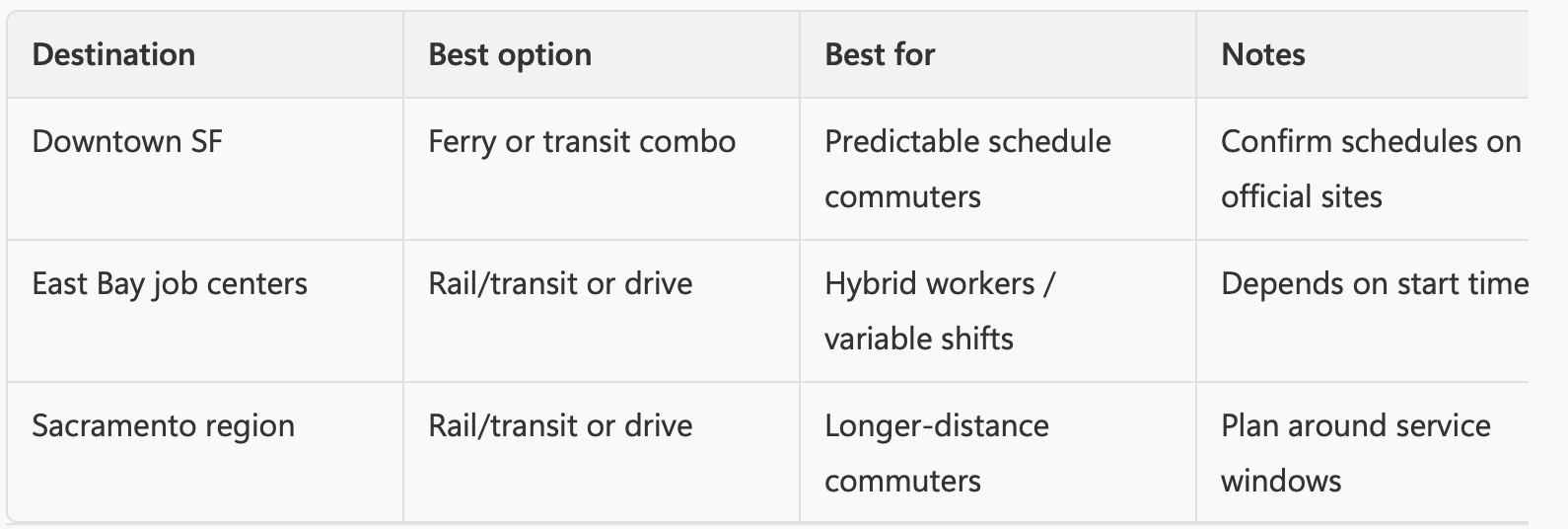
BART (Bay Area Rapid Transit) is the region’s primary rapid transit network, connecting San Francisco with much of the East Bay and parts of the South Bay. According to BART’s official “Using BART” guide, service currently extends to Millbrae, Richmond, Antioch, Dublin/Pleasanton, and Berryessa/North San José, with connections to other local transit systems. [bart.gov]
Many renters pair BART with ferries, buses, biking, or driving, depending on where they live and when they work.
Commute Options Matrix
Links to Popular Commute Options
Helpful tip: Test or map your commute for the exact days and times you expect to travel, not just the distance.
Value Framing: Space, Access, and Trade‑Offs
Without focusing on numbers, many renters describe East Bay living as offering different trade‑offs than the San Francisco core.
People often mention:
More living space or separation from high‑traffic areas
Easier access to parks, parking, or everyday errands
A calmer residential feel while staying regionally connected
These differences don’t make one area better than another—but they can matter when you’re settling into a demanding new role.
Helpful tip: Think about value in terms of how your home supports your workweek and your recovery time.
Relocation‑Ready: How Our Property Management Team Helps
Relocating from out of the area is smoother when logistics are clear and predictable.
Our property management team regularly assists incoming renters with:
Virtual tours to narrow options before arrival
Online applications and document handling
A move‑in readiness checklist so expectations are clear from day one
Our goal is to make the process steady and organized, especially when your focus is on starting a new job.
Helpful tip: Ask early which steps can be completed remotely—this often shortens the overall move‑in timeline.
Coming Up Next
In Post #2, we’ll look more closely at East Bay and Solano County locations through a commuter lens, including how different areas align with hybrid schedules.