Why The East Bay Works for Bay Area Job Relocations

Relocating for Work? A Practical Look at the San Francisco East Bay
Starting a new job in the Bay Area often means making housing decisions quickly—sometimes before you’ve had a chance to learn the region. For many out‑of‑area renters, the San Francisco East Bay offers a steady, workable place to land while getting oriented.
When we say East Bay here, we’re including the Oakland, Berkeley, and Alameda corridor, as well as areas farther east such as Solano County and other communities often chosen for their commuter access and day‑to‑day livability.
This first post in our relocation series focuses on why the East Bay is frequently considered by renters who want predictable commutes, accessible weekends, and a smoother move‑in process.
Relocation Snapshot: Why the East Bay Works When You’re Starting a New Job
Relocating for work usually comes with competing priorities: proximity to the office, a comfortable place to live, and enough flexibility to adjust once you’re on the ground.
The East Bay works for many new arrivals because it combines:
Direct connections to San Francisco and East Bay job centers
Established neighborhoods with everyday services close by
A mix of urban cores and lower‑density areas as you move farther east
For hybrid workers, this layout can make it easier to balance in‑office days with quieter time at home—especially while you’re still learning your new schedule.
Helpful tip: Start your housing search with your work location(s) in mind, then zoom out to areas that offer more than one reliable way to get there.
After‑Work Nature: Easy Outdoor Resets
One thing many renters notice quickly is how accessible outdoor space is across the East Bay.
Depending on where you live, that might include:
Neighborhood parks integrated into residential areas
Shoreline paths along the bay and estuary
Regional parks and hills reachable after work or on short weekend trips
These spaces tend to be part of daily routines rather than special outings, making it easier to fit in a walk or quiet break after logging off.
Helpful tip: When touring rentals (virtually or in person), note how close the nearest park or open space is—you’ll likely use it more than expected.
Weekend Culture: Museums, Dining Districts, and Events
Weekends in the East Bay don’t require long drives or extensive planning.
Across Oakland, Berkeley, Alameda, and nearby cities, you’ll find:
Museums and cultural institutions open year‑round
Distinct dining areas with independent restaurants and cafés
Community events, art walks, and public gatherings that vary by season
As you move farther east, including parts of Solano County, weekends often shift toward local main streets, open spaces, and waterfront or agricultural areas—still active, just at a different pace.
Helpful tip: Choose a home location where at least one weekend activity is easy to reach—it helps a new place feel familiar faster.
Work & Job Hubs: What People Commute To
The East Bay supports a wide range of employment centers, which is helpful when roles, teams, or work patterns change.
Common commute destinations include:
Downtown Oakland and Berkeley business districts
Healthcare, education, and research campuses
Industrial, logistics, and port‑related employment areas
San Francisco offices reached via regional transit
Some renters travel daily, others a few days per week. Many plan housing around flexibility rather than a single commute route.
Helpful tip: Even if your role starts remote or hybrid, think ahead about how easily you could adjust to more in‑office time later.
Commute Playbook: Understanding Regional Options
Commute predictability is a top concern for relocating renters.
BART (Bay Area Rapid Transit) is the region’s primary rapid transit network, connecting San Francisco with much of the East Bay and parts of the South Bay. According to BART’s official “Using BART” guide, service currently extends to Millbrae, Richmond, Antioch, Dublin/Pleasanton, and Berryessa/North San José, with connections to other local transit systems. [bart.gov]
Many renters pair BART with ferries, buses, biking, or driving, depending on where they live and when they work.
Commute Options Matrix
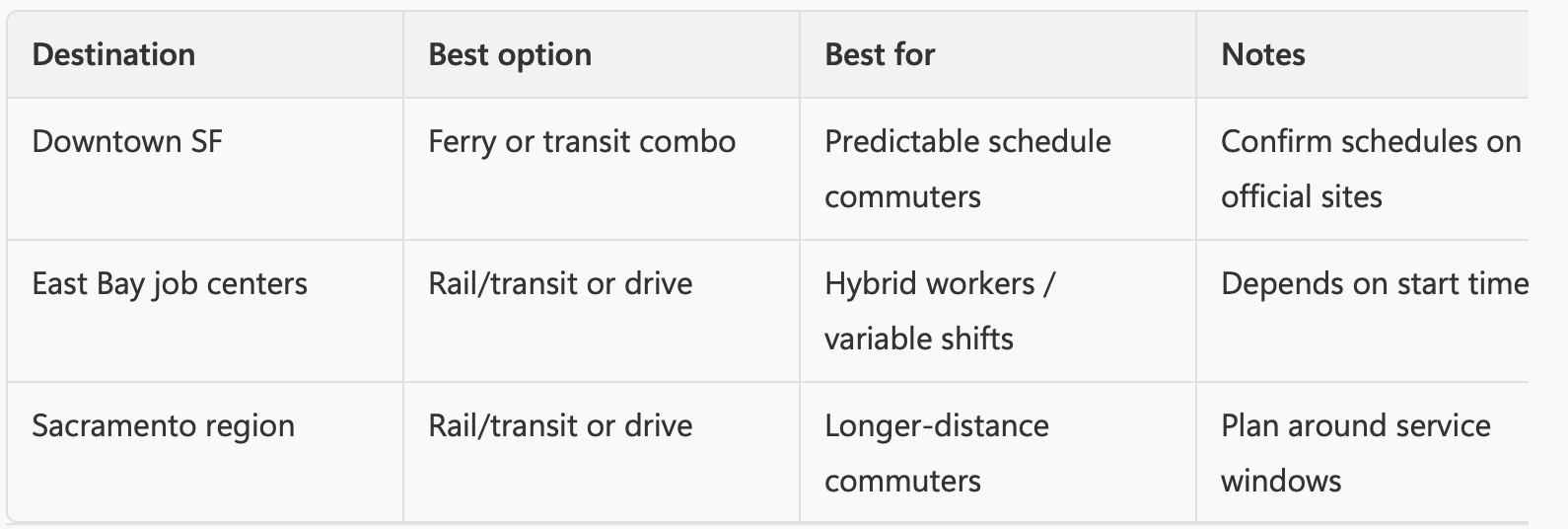
Links to Popular Commute Options
Helpful tip: Test or map your commute for the exact days and times you expect to travel, not just the distance.
Value Framing: Space, Access, and Trade‑Offs
Without focusing on numbers, many renters describe East Bay living as offering different trade‑offs than the San Francisco core.
People often mention:
More living space or separation from high‑traffic areas
Easier access to parks, parking, or everyday errands
A calmer residential feel while staying regionally connected
These differences don’t make one area better than another—but they can matter when you’re settling into a demanding new role.
Helpful tip: Think about value in terms of how your home supports your workweek and your recovery time.
Relocation‑Ready: How Our Property Management Team Helps
Relocating from out of the area is smoother when logistics are clear and predictable.
Our property management team regularly assists incoming renters with:
Virtual tours to narrow options before arrival
Online applications and document handling
A move‑in readiness checklist so expectations are clear from day one
Our goal is to make the process steady and organized, especially when your focus is on starting a new job.
Helpful tip: Ask early which steps can be completed remotely—this often shortens the overall move‑in timeline.
Coming Up Next
In Post #2, we’ll look more closely at East Bay and Solano County locations through a commuter lens, including how different areas align with hybrid schedules.